Bubble Associations: Word Game
NewPubCoWord
4.824.00 Reviews
- Version
- 1.07.00
- Installs
- 10.00K
- Age Rating
- Everyone
Screenshots
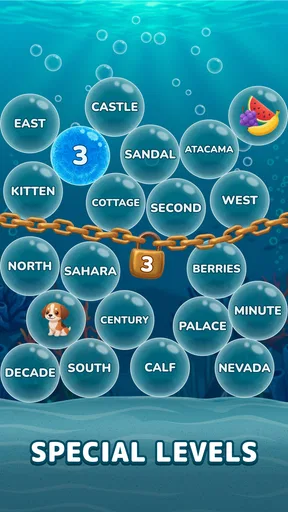
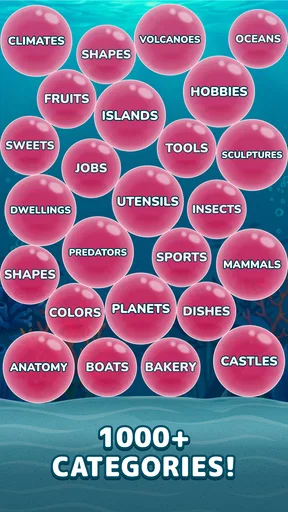
Our Review of Bubble Associations: Word Game
 Analysis by Appyee
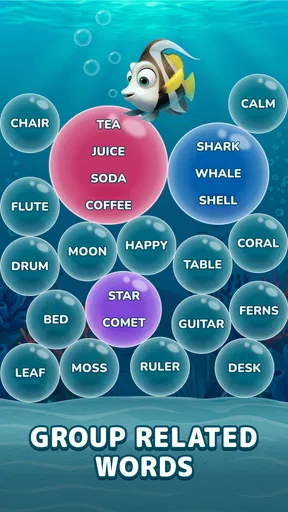
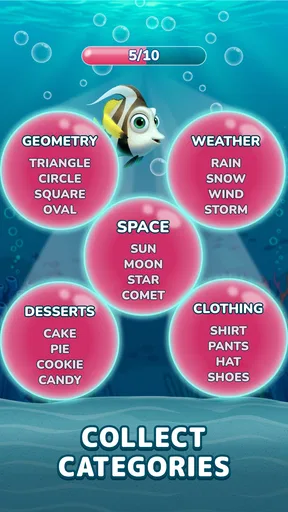
I found Bubble Associations: Word Game most interesting when I stopped treating it like a traditional word quiz. Its central idea is simple: words appear as bubbles, and I merge related ones to reveal broader categories. That creates a small but satisfying reasoning loop. I am not merely searching for a synonym or spelling an answer; I am testing whether several clues belong together and deciding which connection is strong enough to trust.
That distinction gives the game its personality. It is a free word game from NewPubCo, rated for Everyone, and it is easy to understand within a few moments. The store summary describes the experience as merging word bubbles, uncovering categories, and exercising the brain, but my impression is more specific: this is a light association puzzle designed for short sessions, with enough uncertainty to make familiar words feel less obvious.
My overall view is positive, with an important qualification. I would recommend it to someone who enjoys calm, compact word puzzles and likes discovering relationships between ideas. I would not choose it for a player looking for a deep campaign, a competitive leaderboard experience, or the precise vocabulary challenge of a crossword. Its strength is accessible mental sorting, not complexity for its own sake.
How the word-bubble mechanic feels in practice
The basic interaction is approachable because the visual metaphor does most of the explaining. A bubble represents a word, and combining related bubbles gradually points toward a category. That makes the game feel more tactile than a plain list of questions. I found myself scanning the whole group first instead of reacting to one clue at a time, which is a small but meaningful change in how I approached word games.
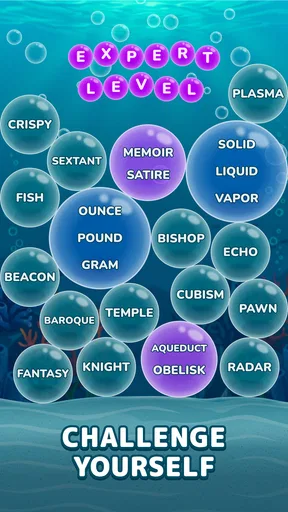
The best moments came when a category was not immediately obvious. A word might seem to fit one possible group, yet another bubble would suggest a more precise relationship. I had to hold several interpretations in mind and avoid committing too quickly. That is where the “brain training” angle feels most credible as a description of the activity—not because the game turns into a formal lesson, but because it encourages flexible thinking and careful comparison.
The real appeal is the pause between recognition and commitment. I often knew that two words were connected, but the useful question was whether they belonged together in the same category as the remaining bubbles. That extra step gives the otherwise simple merge action some texture. It also means the game can be enjoyed by people who prefer reasoning over speed.
Another strength is its low barrier to entry. You do not need to learn a complicated control scheme or memorize a large rulebook. Someone who has played casual word games should understand the objective quickly, while a less experienced player can begin by looking for the most direct relationship. The design concept also suits a phone well: a few bubbles are easier to examine during a short break than a dense puzzle grid.
I would use it in situations where I want something more engaging than scrolling but less demanding than a full game session. For example, during a coffee break, I could play until I reach a puzzle that deserves more thought, then put the phone away without feeling that I have abandoned a long mission. That stop-and-start quality is valuable for a casual title, especially when I do not want sound, reflexes, or a large story to manage.
Why the category discovery matters
The category element gives the game more replayable thought than a straightforward matching exercise. If the only task were to join obvious pairs, the novelty would disappear quickly. Here, I am also trying to understand what kind of group the game is building. That makes each successful merge feel like a partial explanation rather than a simple correct tap.
I found it helpful to sort clues mentally into three levels. First, I looked for direct relationships that seemed unlikely to be misleading. Next, I considered words with multiple meanings, since those could connect to more than one possible group. Finally, I used the remaining bubbles to test the category instead of forcing a favorite interpretation. This approach reduced random guesses and made the puzzles feel more deliberate.
That is one of the less obvious ways to get more from the game: do not merge the first plausible pair automatically. Keep a possible category in mind and ask whether it can accommodate the other words. A relationship that feels clever in isolation may be wrong for the larger set. This habit turns the game from casual tapping into a small exercise in evidence-based deduction.
It also makes the experience suitable for different ages within the Everyone rating. Younger players can focus on familiar associations, while adults may enjoy the ambiguity of words that can belong to several conceptual groups. The difficulty, as I experienced it, comes less from obscure trivia and more from seeing the intended connection among ordinary language.
Where the game is less satisfying
The same simplicity that makes the game approachable can limit it for experienced puzzle players. If I want the layered clueing of a crossword, the exactness of a spelling game, or the pressure of a timed word challenge, this title is not a direct substitute. Its puzzles are built around grouping and association, so players who prefer strict answers may find the logic softer than they expect.
There is also a potential frustration in the subjective feeling of some relationships. Word association is naturally more open-ended than a definition with one clear solution. Even when the intended category becomes understandable, I may still feel that another grouping would have been reasonable. That is not necessarily a flaw in the concept, but it does affect how fair a puzzle feels from one player to another.
My advice is to approach a stubborn puzzle by widening the category rather than repeating the same guess. Ask what the words have in common in everyday language, not what single definition they share. If I keep trying to force a narrow interpretation, the game becomes irritating; if I treat the set as a pattern to uncover, the ambiguity becomes part of the challenge.
Players should also be aware that the game is free but includes in-app purchases ranging from $1.99 to $99.99 per item. That price range is worth noticing before playing, particularly for anyone handing a phone to a child. I would review the device’s purchase controls in advance and decide whether optional spending should be restricted. The free entry point is convenient, but the presence of purchases means it should not be treated casually on a shared device.
The current version is 1.07.00, and the game requires at least Android 7.1. That makes it relevant to people using older compatible Android phones, although the practical experience will still depend on the device. I would expect the bubble-based interface to be more comfortable on a screen where words are easy to read and touch accurately. On a very small or aging display, the visual simplicity may not fully compensate for cramped text.
Who will get the most from it
I think the strongest audience is anyone who likes word games but does not always want a dictionary, a timer, or a competitive score. The game offers a gentle mental workout that can fit into spare moments. It is especially suitable for players who enjoy spotting themes, comparing meanings, and finding a connection that was not obvious at first glance.
It could also work well as a shared puzzle between family members or friends. One person can suggest a connection while another questions whether it fits the wider group. Because the central action is easy to explain, a new player does not need a long tutorial before joining in. The most enjoyable conversations would probably come from disagreements over whether a tempting pair belongs together, rather than from racing to finish.
For a daily routine, I would use a simple three-pass method. On the first pass, I would identify only the strongest relationships. On the second, I would inspect the leftover words for a common theme. On the third, I would reconsider any early merge that left an awkward remainder. This workflow is more reliable than tapping based on the first association that comes to mind, and it helps preserve the puzzle-solving aspect.
I would be more cautious recommending it to someone who needs a clearly measurable learning tool. Although the game encourages attention to meaning and categories, it is still entertainment rather than a structured language course. It may support vocabulary awareness indirectly, but I would not replace a spelling trainer, dictionary app, or formal study resource with it.
Likewise, competitive players may prefer a game built around rankings, timed rounds, or head-to-head play. Bubble Associations: Word Game seems better suited to private problem-solving than performance pressure. That is a benefit if I want to relax, but a limitation if my motivation depends on visible progress against other people.
How it compares with familiar word-game alternatives
Compared with a crossword, this game asks less from memory and more from categorization. A crossword usually rewards exact spelling, clue interpretation, and crossing letters that confirm an answer. Here, the useful evidence comes from the relationships among bubbles. I would pick the crossword when I want a longer, more structured puzzle, and this game when I want a quicker exercise in recognizing themes.
Compared with a word-search game, the experience is less about scanning a fixed arrangement for hidden letters. The challenge is conceptual rather than visual. Someone who enjoys finding patterns on a grid may not automatically prefer this format, but a player who likes sorting ideas could find it more mentally engaging than searching for letter strings.
Compared with a spelling or vocabulary quiz, the game is more forgiving in its entry point but less precise in what it tests. I do not need to produce a perfectly spelled answer from memory. Instead, I need to understand how words relate. That makes it friendlier for casual play, while a serious language learner may still want an alternative that explains definitions, pronunciation, or usage.
The closest comparison is probably another category-matching puzzle, yet the bubble presentation gives this one a more physical sense of progress. Each merge feels like the puzzle is being reduced and clarified. I would not call that a revolutionary mechanic, but it is a well-chosen interface for the kind of thinking the game wants from me.
Practical expectations before installing
The game has an average rating of 4.8 from over 300 ratings, with 24 written reviews, and it has passed 10K installs. Those figures suggest that it has found a receptive audience, but I would still treat them as a starting point rather than a guarantee that every puzzle style will suit me. Ratings can confirm that the concept appeals to many players; they cannot remove the personal question of whether I enjoy open-ended associations.
NewPubCo has kept the product’s identity focused on the word-puzzle idea rather than surrounding it with unnecessary complexity. That focus is a plus for anyone who wants to open the app and begin thinking immediately. At the same time, focused casual games can feel limited if I play for long stretches. I would approach it as a compact activity, not as the only game I expect to keep me occupied for hours.
Because it is free to start, the sensible way to judge it is to play without assuming that the purchase options are required for enjoyment. If I like the core merging and category discovery, I can decide later whether any optional item is worthwhile. I would avoid spending simply to overcome impatience with a difficult puzzle; taking a break and returning with a fresh interpretation is more in keeping with the game’s strengths.
The age rating of Everyone also makes it broadly accessible, but adults should still remember that age suitability and spending suitability are different questions. If a child uses the device, purchase protections matter even when the game itself is appropriate for young players. That is a practical detail I would consider before sharing it with family.
My final recommendation
After spending time with it, I see Bubble Associations: Word Game as a polished idea for small pockets of attention. It turns familiar words into a process of testing, grouping, and revising assumptions. The strongest puzzles reward patience rather than speed, and the bubble format makes the progress easy to follow without demanding a complicated tutorial.
Its limitations are equally clear. The association-based answers may feel less exact than crossword clues, the experience may not satisfy competitive players, and extended sessions could expose the narrowness of the central loop. The in-app purchase range also deserves careful handling on shared devices. None of those points cancels the concept, but they define the audience that will appreciate it.
I would recommend it to a friend who wants a free, approachable word game for breaks, quiet evenings, or casual family discussion. I would suggest a crossword for deeper structured solving, a spelling app for language practice, and a competitive word title for timed excitement. If your ideal puzzle asks you to look at several ordinary words and discover the hidden group connecting them, this is a worthwhile choice.
My verdict: a thoughtful, easy-to-start category puzzle that earns its place through clever associations, provided you prefer relaxed reasoning over strict answers or high-pressure competition.
Verdict
Strengths of Bubble Associations: Word Game
- Simple rules make it easy to start playing immediately.
- Short rounds fit well into quick breaks or casual sessions.
- Word associations encourage flexible and creative thinking.
- Clean gameplay keeps the focus on solving each puzzle.
- Suitable for players who enjoy relaxed, vocabulary-based challenges.
Limitations of Bubble Associations: Word Game
- Some puzzles may accept only one expected word or interpretation.
- Difficulty can feel inconsistent between consecutive levels.
- Repeated puzzle patterns may reduce long-term variety.
- Hints or extra attempts may be limited without in-app purchases.
- Players seeking action or competitive multiplayer may find it too slow.
Other Releases by NewPubCo
View All


Similar Picks in This Category
View All
Word Search - Word Puzzle Game
Bluetile4.8

Word Search Quest - Puzzles
Blackout Lab4.8

CodyCross: Crossword Puzzles
Fanatee, Inc.4.7

Words of Wonders: Crossword
Fugo Games4.9

Wordscapes: Word puzzle game
PeopleFun4.7

Word Search Explorer
PlaySimple Games4.9
Frequently Asked Questions
What is Bubble Associations: Word Game?
Bubble Associations: Word Game is a casual word puzzle that challenges you to connect related words and discover the correct association. Each level presents a group of bubbles containing words, and your task is to identify the logical relationship between them. It is designed for short play sessions, but the increasing difficulty can keep you engaged for much longer.
How do you play Bubble Associations: Word Game?
The basic gameplay is easy to understand: read the words shown in the bubbles, look for a common theme or connection, and select the words that belong together. Some puzzles are immediately obvious, while others require lateral thinking and careful attention to wording. As you progress, the game introduces more challenging combinations that test vocabulary, reasoning, and pattern recognition.
Is Bubble Associations: Word Game suitable for beginners?
Yes, the game is suitable for beginners because its controls and rules are simple, and the early puzzles provide a gentle introduction to the association mechanic. However, it is not limited to casual players. Later stages can be surprisingly difficult, especially when several words appear to fit the same category. Players who enjoy word games, trivia, and brain-training challenges should find the learning curve comfortable but rewarding.
Can Bubble Associations: Word Game be played offline?
Many puzzle games allow at least some content to be played without a constant internet connection, but offline availability can depend on the version installed and the platform. An internet connection may still be required for advertisements, cloud synchronization, updates, rewards, or in-app purchases. For the most reliable experience, launch the game online first and check whether your downloaded levels remain accessible when connectivity is disabled.
Does Bubble Associations: Word Game include hints, advertisements, or in-app purchases?
The game may provide optional hints or assistance when you are stuck, commonly through earned rewards, advertisements, or in-app purchases. Advertising can also appear between levels or during longer sessions, depending on the edition and device. Before downloading, review the store listing for the current monetization details. If the game offers purchases, parental controls and device-level purchase restrictions are recommended for younger players.
Play our best games!


